
Celebrating International Women's Day 2025
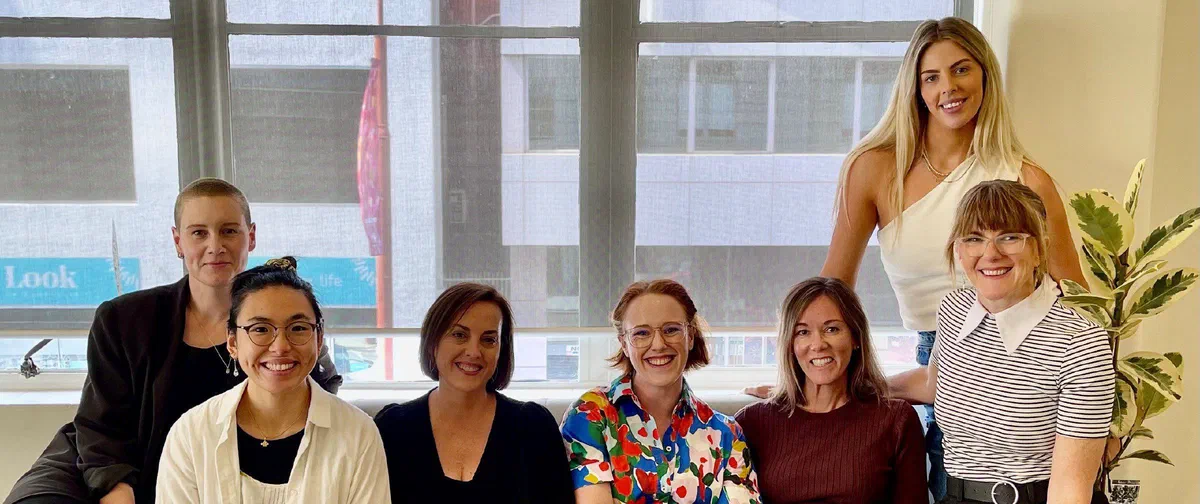
As we mark International Women’s Day, we want to share the transcript of a speech that truly resonates on this day and every day. ConMoto’s Head of Legal, Catherine Scott, the 2025 recipient of the Tasmanian Law Society President’s Award, delivered a thoughtful and impactful acceptance speech putting a spotlight on gender bias.
Cath’s commitment to improving opportunities for women is clear in every word. Her speech is insightful, measured and a reminder of why continued progress matters. We are so proud to celebrate her achievements and the positive change she advocates for. And we’re proud to celebrate and acknowledge all of the women at ConMoto (and all around the world) who have the same values and dedication to creating change, empowering women, and striving for gender equality.
Read the full transcript below—we hope it sparks as much reflection and conversation for you as it has for us.
Thank you to Trevor McKenna and Luke Rheinberger for trusting me with that gig of rolling out the Sexual Harassment, Changing Workplace Culture seminar for the last couple of years. That was really, for me, something that came at a time when (having a couple of decades under my belt in this area), I was looking for an opportunity to do something to improve the legal profession for women, to improve the environment that we work in. Because I just watched too many young talented women leave, and leave because they thought that their future looked better in another profession.
And whilst that seminar on sexual harassment was never going to be the whole solution, it was certainly something that enabled us to tackle a problem that disproportionately affects women in the profession. So upwards of 80% of victims of sexual harassment are young women in fact. And when you break it down, what that’s about is respect. So a profession that respects their women does not tolerate sexual harassment.
And so we had this moment, many moments, 44 plus moments, where we came together and we asked everybody not only to understand and condemn those behaviours, those toxic behaviours, but we also asked everybody to do what they can to stamp it out. And that was really powerful. That was us coming together, realising that we can stamp out sexual harassment if we choose to do so.
And the other point that Will Justo mentioned, the other amazing opportunity that I got to be a part of more recently was the Ladies’ Lounge Appeal, that you might have heard of. It got a little bit of attention around the state, and around the world, mostly because the driving force behind this artwork was a force of nature who basically loves to stir shit up and had the freedom and the opportunity to do so with this court case.
And look, you can read the court case. There’s a bit of law involved in that. But really what this was about was an artwork that deliberately discriminated on the basis of gender. There was no doubt it did so - men, you can’t come in; women, you can. Men, you have a think about why you can’t come in. And women, you come and enjoy that you can come in. And it definitely was discriminatory. And the only course open to us was to argue that it promoted equal opportunity. And how? How can a piece of artwork do that?
Well, what we argued, as was said earlier, was that it was actually about addressing gender bias, this toxic force that exists silently in the back of our heads. And the disadvantage that women suffer is not disputed. And it wasn’t disputed at all in the court case. The statistics are pretty clear that women suffer disadvantage across a range of different areas. More likely to be the victims of domestic violence, sexual harassment, sexual assault. More likely to do unpaid labour. There’s a gender pay gap that still exists. So if you want to think about it in that way, in reality, women are less safe, less respected, less valued, and less powerful than men. And that’s in Australia in 2024.
But the other thing that this court case gave us the opportunity to point out is that there’s nothing wrong with women. Women don’t deserve to be treated as less. There’s nothing that we’ve done or haven’t done that means that we should be treated as less. The reason that we’re treated as less is because of gender bias. It’s because we accept that treatment because we don’t think about it.
Now what the Ladies’ Lounge did was point that out and also point out the arbitrary nature of gender bias. So this thing that sits in our head and makes us think that women are less capable, it makes us more likely to interrupt women when they speak. Less likely to listen to their opinions, to dismiss their opinions, and feel that they are worthy of less respect. It sits silently in our heads and it impacts our decisions because we choose to let it sit there. So in the same way as currently we choose to let men have privilege, the Ladies’ Lounge showed us we can just as easily choose to have women have that privilege. Or even better, we can choose that no one has that privilege.
And the reaction to the Ladies’ Lounge was overwhelming for me. Part of it was because of the silliness that went with this court case, right? The whole other show and the artwork that seemed to go beyond the court case in a large way. And obviously as the lawyer I don’t get to participate in that silliness - although yes, I did drop the Taylor Swift quote. “If I was a man, I’d be the man.” But in my defence, and Justice Marshall isn’t here today, but in my defence, what actually happened - to give that context - was that the opposing counsel referenced some opera in his closing submissions. And Justice Marshall said, “I don’t understand the reference, I’m more of a Taylor Swift fan”. So as reluctant as I am to use the phrase that the Judge was asking for it, the Judge was asking for it! There was no way I couldn’t point out the very apt phrase from the wonderful philosopher Taylor Swift, which is, “If I was a man, I’d be the man”.
And I think it (the court case) resonated even more so with us women. I got so many messages - and thank you for all of the contact that you guys made after that case was handed down - from women, because I think it resonates quite strongly with us as women lawyers. Because our job, to be good at our job, we need people to listen to us, to accept our opinion, to accept that what we say has value. And as women, we need to remind ourselves when we’re interrupted or when our opinion is dismissed or when there is gender bias in the room, that there’s nothing wrong with us, it’s not us. (I mean I might be a bit shit on the day on a particular day!), but at a global level, there’s nothing wrong with us.
But we also need everybody to be prepared. If we want to tackle gender bias in the same way as we asked you all to tackle sexual harassment, we have to be prepared to examine the contents of our own head. And think about whether what we’re thinking, what we’re feeling, what we’re saying, whether we’re interrupting women more, is because of this thing that sits in the back of our head. Because we can change it. We can choose for it not to exist. It’s actually pretty easy.
So if you would come with me, like you did in terms of stamping out sexual harassment, it would be great if we could do the same thing with gender bias.
Before I go, quickly, and thank you for listening, I do want to quickly shout out to Table 11, my beautiful ConMoto family sitting there. A couple of years ago, there were three or four of us, now we can more than fill a table. And the success of ConMoto is very much down to the culture that you guys live every day, that you guys bring. That’s what makes it such an amazing place to work.
Thank you.